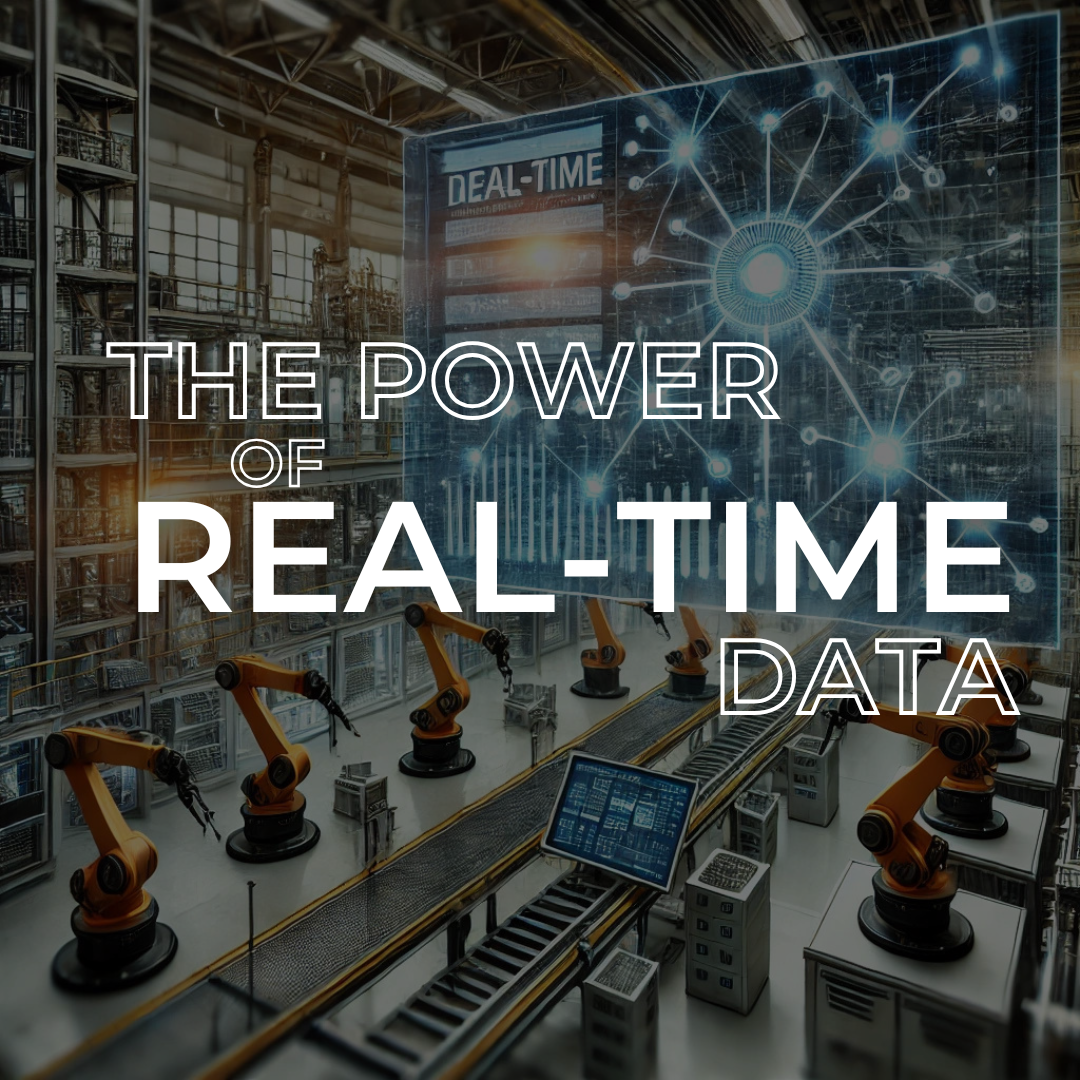
A Key Driver of Efficiency and Innovation
In the growing world of industrial automation, real-time data exchange has become a critical component for ensuring operational efficiency, optimizing processes, and maintaining a competitive edge. Real-time communication between machines, sensors, controllers, and supervisory systems enables manufacturers to monitor and control their production lines more effectively, reducing downtime, improving quality, and increasing throughput.
This seamless flow of data is the backbone of Industry 4.0, where smart factories rely on advanced technologies to drive automation, productivity, and innovation.

Our latest article takes us on a journey to explore the fundamentals of real-time data exchange in industrial automation, how it works, the benefits it brings to the likes of our clients, and the technologies that make it possible.
What Is Real-Time Data Exchange?
Real-time data exchange refers to the immediate and continuous transmission of information between devices, systems, and networks within a manufacturing environment. This allows for instant communication and decision-making, which is vital for processes that require precise timing and coordination, such as robotic assembly, conveyor systems and quality control.
Components of Real-time data exchange:
- Data generation: Sensors and machines collect data constantly, related to production processes, such as temperature, pressure, speed and status.
- Data transmission: This data is sent to controllers (such as Programmable Logic Controllers, or PLCs) or supervisory systems for analysis and action.
- Data processing: Controllers process the data in real-time, making decisions based on the information received (e.g. adjusting machine settings, triggering an alarm, etc).
- Data feedback: The decisions or adjustments are relayed back to the machines or systems to ensure that operations continue smoothly, within a reliable manner.
The entire process must happen within milliseconds to ensure that machines, robots and other systems work in sync without any delays that could lead to production inefficiencies or errors.

What is the Role of Real-Time Data Exchange in Industrial Automation?
Real-time data exchange plays a vital role in optimizing manufacturing operations. Here are some key areas where it makes a significant impact:
1. Process Control
In industrial environments, real-time data exchange is crucial for process control. Manufacturing processes rely on tight control over variables like temperature, pressure, and flow rates. Any deviations from set parameters can lead to defective products, production slowdowns, or even equipment damage.
By collecting and analysing data in real-time, control systems can automatically adjust processes to maintain optimal conditions. For example, in a chemical processing plant, temperature and pressure sensors may continuously transmit data to a PLC, which adjusts valves and heaters to maintain the right conditions. If the data indicates a problem, such as a temperature spike, the system can immediately trigger alarms and corrective actions, preventing damage or waste.
2. Predictive Maintenance
One of the most significant benefits of real-time data exchange is predictive maintenance. Traditional maintenance strategies rely on scheduled checks or reactive repairs after a breakdown occurs. This can lead to costly downtime and inefficiencies.
With real-time data, manufacturers can continuously monitor the health of their equipment and predict when maintenance is needed. Sensors on machines transmit data about vibration levels, temperature, and other parameters that indicate wear and tear. When the data suggests that a component is nearing failure, maintenance teams can intervene before a breakdown occurs, reducing unplanned downtime and extending the lifespan of equipment.
3. Quality Control
In high-precision manufacturing environments, maintaining product quality is paramount. Real-time data exchange allows manufacturers to monitor quality parameters continuously throughout the production process.
For instance, in an automotive assembly line, sensors and vision systems can inspect parts as they are being assembled. Any deviations from the desired specifications can be detected immediately, allowing for adjustments or the removal of defective products before they reach the next stage of production. This ensures consistent quality and reduces the risk of defective products reaching the end customer.
4. Operational Efficiency and Flexibility
Real-time data exchange enhances operational efficiency by allowing machines and systems to communicate and coordinate actions instantaneously. This is particularly important in just-in-time manufacturing, where production schedules are tightly controlled to minimize inventory costs and meet demand.
In smart factories, machines can autonomously adjust their production speeds, assembly patterns, or material usage based on real-time data. For example, if a bottleneck is detected in one part of the production line, the system can dynamically adjust the pace of other machines to maintain balance and prevent delays.
Additionally, real-time data enables mass customization, where manufacturers can rapidly switch production setups to meet specific customer requirements without compromising efficiency. This flexibility is a critical advantage in industries where customer preferences or market demands change rapidly.
Which Technologies Enabling Real-Time Data Exchange?
Industrial Ethernet protocols, such as EtherNet/IP, PROFINET, and Modbus TCP, have largely replaced traditional fieldbus systems due to their higher speed, reliability, and scalability. Ethernet-based networks allow for real-time communication between devices, PLCs, and supervisory systems, ensuring that data is transmitted and processed within milliseconds.
One of the key advantages of Ethernet protocols is their ability to handle large volumes of data from numerous devices simultaneously, making them ideal for modern, data-intensive manufacturing environments.
As manufacturing environments become more complex, with increasing numbers of connected devices, ensuring that critical data is transmitted in real time becomes more challenging. Time-Sensitive Networking (TSN) is an emerging technology designed to address this challenge.
TSN is a set of standards for Ethernet-based communication that provides guaranteed, low-latency, and deterministic communication. This is particularly important in applications like robotics or motion control, where precise timing is essential for safe and efficient operation. TSN ensures that time-critical data gets priority over less urgent data, preventing delays and synchronization issues in automated systems.
OPC Unified Architecture (OPC UA) is a platform-independent, vendor-neutral communication protocol that has become the standard for data exchange in industrial automation. It facilitates secure and reliable communication between devices, systems, and applications, regardless of the manufacturer or operating system.
OPC UA supports real-time data exchange by allowing systems to share data continuously, whether it's between machines on the factory floor or between production systems and higher-level business systems. Its flexibility and scalability make it a key enabler of Industry 4.0 initiatives.
As industrial automation embraces the Industrial Internet of Things (IIoT) and smart factories, the need for faster, more reliable communication networks is growing. 5G networks, with their ultra-low latency and high bandwidth, are poised to revolutionize real-time data exchange in industrial environments.
In combination with edge computing, where data processing occurs closer to the source (i.e., on the factory floor), 5G enables faster decision-making and reduces reliance on centralized cloud systems. This is particularly beneficial for applications that require instant data processing, such as autonomous robots, real-time quality inspection and predictive maintenance.
Benefits of Real-Time Data Exchange in Industrial Automation
The advantages of real-time data exchange in industrial automation are vast, providing manufacturers with several key benefits:
- Increased Productivity: By enabling machines to communicate and make decisions instantaneously, manufacturers can optimize production speeds, reduce bottlenecks, and improve overall throughput.
- Reduced Downtime: Real-time monitoring and predictive maintenance help prevent unexpected equipment failures, reducing costly downtime and ensuring uninterrupted production.
- Improved Quality: Continuous monitoring of quality parameters during production ensures that defects are detected early, reducing waste and improving product consistency.
- Enhanced Flexibility: Real-time data exchange enables manufacturers to quickly adapt to changes in production demands, allowing for mass customization and faster response to market trends.
- Cost Savings: By optimizing processes, reducing downtime, and improving resource allocation, real-time data exchange leads to significant cost savings over time.
Conclusion
In the current era of Industry 4.0, real-time data exchange is at the heart of modern industrial automation. It empowers manufacturers to optimize processes, improve quality and maintain flexibility in an increasingly competitive marketplace. As technologies like Industrial Ethernet, TSN, OPC UA, and 5G continue to advance, the potential for real-time data exchange to revolutionize industrial automation will only grow, driving innovation and efficiency to new heights.
Onicavox strives to maintain a constant environment of learning, allowing us to lead the way in key developments within the industrial automation space. With clients such as Rivian Electric Vehicle, Ford Motor Company and the like, trusting us to bring an 'A-game' to their production performance, we're constantly inspired to bring them the best solutions the automation space has to offer.
_________________________________________________________________________________________
Here at Onicavox we strive to be at the forefront of the future of automation, empowering businesses across industries by helping them optimise their operations and maximising productivity. As a leading provider of cutting-edge automation solutions, we strive to transform the way businesses operate, enhancing efficiency, accuracy, and profitability.
Is your business ready to scale-up it's automation game? Onicavox is here to help. Please get in touch.