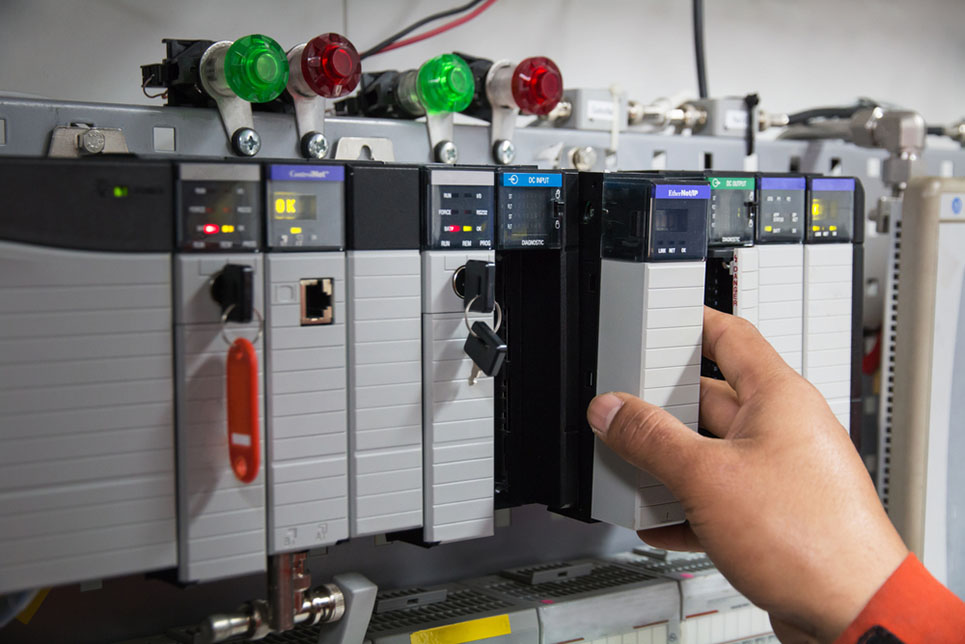
In the realm of industrial automation, Programmable Logic Controllers (PLCs) stand as the backbone, orchestrating the seamless operation of machinery and processes in various industries. PLCs have revolutionized industrial automation, offering flexibility, reliability, and efficiency in controlling complex systems.
Programmable Logic Controllers are the backbone to Industrial Automation Solutions.
Problems are simple to recognize and fix since PLCs are made up of a variety of input and output devices.
Understanding the fundamentals of PLCs, including their programming languages, is crucial for engineers and professionals in the field. In this article, we delve into the world of PLCs, explore the five primary programming languages used in PLC programming, and discuss how to choose the most suitable language for industrial automation applications.
PLCs in Industrial Automation
A Programmable Logic Controller (PLC) is a specialized computer used to control machinery and processes in industrial settings. Originally developed to replace electromechanical relay systems, PLCs have evolved significantly, becoming more powerful and versatile over time. These compact devices are designed to withstand harsh industrial environments and offer real-time control over various inputs and outputs.
PLCs consist of three main components: the central processing unit (CPU), input modules, and output modules. The CPU processes the program logic and communicates with input and output modules to control connected devices such as sensors, actuators, motors, and valves. PLC programming involves writing instructions to define the behavior of the system, specifying how inputs are processed and how outputs are generated.
PLC Programming Languages
PLC programming languages are used to create the logic that controls the operation of industrial processes. While there are several programming languages available, the five most commonly used languages in PLC programming are:
Ladder Logic (LAD): Ladder Logic is the most widely used programming language in PLCs, primarily because of its graphical representation resembling electrical relay logic diagrams. It uses relay-style contacts and coils to represent inputs, outputs, and the logical relationships between them. Ladder Logic is intuitive and easy to understand, making it suitable for beginners and experienced programmers alike.
Structured Text (ST): Structured Text is a high-level programming language similar to Pascal or C. It allows programmers to write code using text-based instructions, making it more flexible and powerful than Ladder Logic for complex algorithms and mathematical operations. Structured Text is often preferred for tasks requiring advanced calculations or data manipulation.
Function Block Diagram (FBD): Function Block Diagram is another graphical programming language that represents control systems as interconnected blocks. Each block performs a specific function, such as arithmetic operations, logical comparisons, or data processing. FBD is useful for visualizing complex control strategies and modularizing code for easier maintenance and troubleshooting.
Instruction List (IL): Instruction List is a low-level programming language resembling assembly language. It uses mnemonic instructions to manipulate data and control the execution flow. While less common than other languages, IL can be more efficient in terms of memory usage and execution speed for certain applications.
Sequential Function Chart (SFC): Sequential Function Chart is a graphical language used to represent sequential control systems. It consists of steps, transitions, and actions organized in a hierarchical structure. SFC is particularly useful for modeling complex sequences of operations, such as startup procedures or state-based control systems.
Choosing the Right Programming Language
Selecting the appropriate programming language for PLCs in industrial automation depends on various factors, including the complexity of the control task, the programming expertise of the team, and the compatibility with existing systems. Here are some considerations to keep in mind when choosing a programming language:
Task Complexity: For simple control tasks with basic logic requirements, Ladder Logic may suffice due to its ease of use and familiarity. However, for complex algorithms or mathematical operations, Structured Text offers more flexibility and readability.
Programming Expertise: Consider the skill level of your programming team. If they are proficient in text-based programming languages like C or Pascal, they may prefer Structured Text over graphical languages like Ladder Logic or Function Block Diagram.
System Compatibility: Ensure that the chosen programming language is compatible with the PLC hardware and software used in your industrial automation setup. Some PLC platforms may support multiple programming languages, allowing you to choose the most suitable option based on your requirements.
Maintenance and Troubleshooting: Factor in the ease of maintenance and troubleshooting when selecting a programming language. Graphical languages like Ladder Logic and Function Block Diagrams are often preferred for their visual representation, which simplifies debugging and modification tasks.
Future Scalability: Consider the scalability of your control system and the potential need for future expansion or modifications. Choose a programming language that supports modularization and abstraction, allowing you to easily add or modify functionality as needed without disrupting the existing system.
In conclusion, PLCs play a pivotal role in industrial automation, providing precise control and monitoring capabilities for a wide range of applications. Understanding the programming languages used in PLCs is essential for developing efficient control strategies and optimizing system performance. Whether you opt for the simplicity of Ladder Logic, the versatility of Structured Text, or the modularity of Function Block Diagrams, choosing the right programming language depends on the specific requirements of your industrial automation project. By considering factors such as task complexity, programming expertise, system compatibility, maintenance needs, and future scalability, you can select the most suitable programming language to achieve your automation goals effectively.
Here at Onicavox we strive to be at the forefront of the future of automation, empowering businesses across industries by helping them optimise their operations and maximising productivity. As a leading provider of cutting-edge automation solutions, we strive to transform the way businesses operate, enhancing efficiency, accuracy, and profitability.
Is your business ready to scale-up it's automation game? Onicavox is here to help. Please get in touch.